
Why Use PLC?
2023-05-05

Programmable Logic Controllers (PLCs) have become an integral part of industrial automation and control systems, providing an efficient and reliable solution for controlling various equipment, processes, and machinery. But why do engineers and industries choose PLCs over traditional relay-based control systems or other alternatives? This article will discuss the key reasons to use PLCs in diverse control applications, emphasizing their flexibility, reliability, scalability, diagnostics capabilities, and ease of integration.

1. Flexibility
One of the primary advantages of using a PLC is the flexibility it offers in controlling a wide variety of processes and equipment:
- Easily Reprogrammable: PLCs can be easily programmed, reprogrammed, or modified to meet different application requirements, changes in equipment, or extensions of a control system.
- Adaptability: Supporting several programming languages, PLCs allow engineers and technicians to create various control strategies, including sequence control, motion control, and process control, using the most suitable programming approach for each application.
- Adaptability: Supporting several programming languages, PLCs allow engineers and technicians to create various control strategies, including sequence control, motion control, and process control, using the most suitable programming approach for each application.

2. Reliability
PLCs are designed to operate reliably in harsh industrial environments, making them an ideal choice for various critical applications:
- Robust Construction: PLCs can withstand extreme temperatures, vibrations, and electrical noise, ensuring consistent and uninterrupted operation in demanding conditions.
- Fail-Safe Features: Many PLCs come with built-in fail-safe features, such as redundant power supplies, central processing units (CPUs), or communication channels, enhancing system reliability and stability.
- Fail-Safe Features: Many PLCs come with built-in fail-safe features, such as redundant power supplies, central processing units (CPUs), or communication channels, enhancing system reliability and stability.

3. Scalability
The modular design of PLC systems allows for easy expansion or modification, ensuring adaptability to accommodate new equipment or extended functionality:
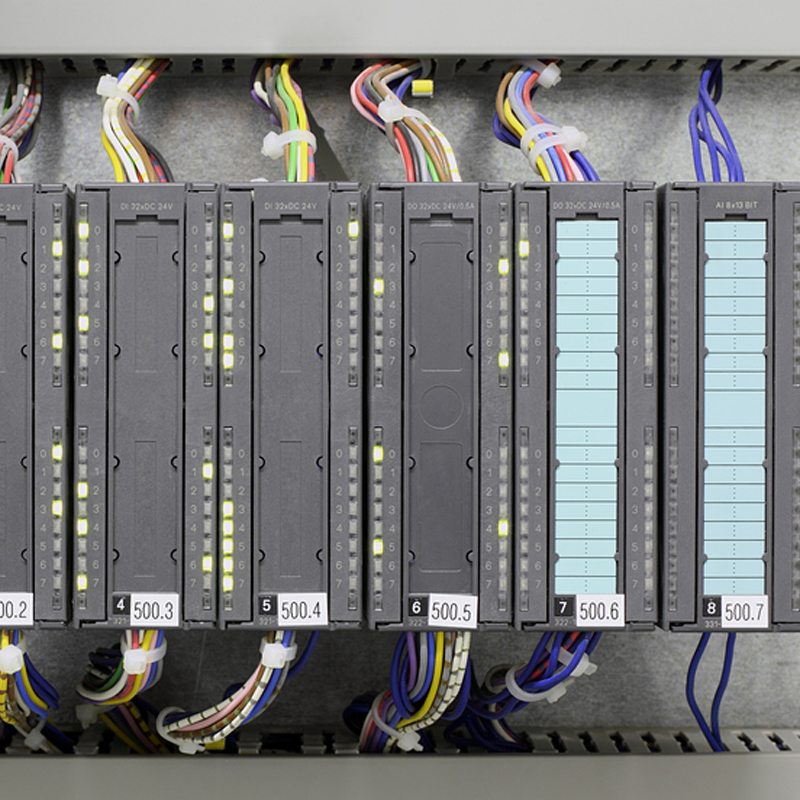
- Expandable I/O: Adding or replacing input/output (I/O) modules as required, PLCs can be easily scaled to support a growing number of sensors, actuators, or system components.
- Flexible Architecture: PLCs are available in different sizes and configurations, ranging from small, standalone systems to complex, rack-mounted, or networked systems that can be tailored to suit the needs of diverse applications.
- Flexible Architecture: PLCs are available in different sizes and configurations, ranging from small, standalone systems to complex, rack-mounted, or networked systems that can be tailored to suit the needs of diverse applications.

4. Diagnostics Capabilities
PLCs provide powerful diagnostic capabilities, streamlining troubleshooting and maintenance procedures:
- Comprehensive Diagnostics: PLCs can perform self-tests, system checks, and analyze control programs to identify potential issues, generating alarms or notifications for operators or maintenance personnel.
- Easy Troubleshooting: PLC programming software typically includes debugging tools and simulation features, allowing engineers and technicians to quickly identify and resolve problems in the control system.
- Easy Troubleshooting: PLC programming software typically includes debugging tools and simulation features, allowing engineers and technicians to quickly identify and resolve problems in the control system.

5. Ease of Integration
PLCs can communicate with various devices, facilitating seamless integration with other control systems, data acquisition, or visualization solutions:
- Industrial Communication: PLCs support a wide range of industrial communication protocols such as Modbus, EtherNet/IP, Profibus, or Profinet, ensuring compatibility with Human-Machine Interfaces (HMIs), Supervisory Control and Data Acquisition (SCADA) systems, or other PLCs.
- Open Architecture: The open architecture of PLCs enables easy integration with different devices, platforms, or software packages, fostering collaboration and interoperability across various industries.
- Open Architecture: The open architecture of PLCs enables easy integration with different devices, platforms, or software packages, fostering collaboration and interoperability across various industries.
Conclusion
The use of PLCs in industrial control and automation applications offers numerous advantages, including flexibility, reliability, scalability, powerful diagnostics capabilities, and ease of integration with other systems or devices. These benefits, combined with the ability to handle diverse control tasks, make PLCs the preferred choice for optimizing control systems in a wide range of industries. Embracing the potential of PLCs can lead to increased efficiency, reduced downtime, and improved operational performance.
 About the classification, application and development of PLC
  There is a problem with PLC, how to quickly find the cause?
  How many communication methods does Siemens PLC have?
  Siemens PLC S7-300 has communication failure and remote maintenance method
  What are the series and characteristics of Siemens PLC
  Summary of Siemens PLC selection method 2
  Summary of Siemens PLC selection method 1
  What Applications Would You Use PLCs? - Exploring the Widespread Use of Programmable Logic Controllers
  Is PLC Used in Robotics? - Understanding the Role of PLCs in Robotics
  Is PLC Programming Hard? - A Comprehensive Guide to PLC Programming
  What is a PLC in Business?
  What is a PLC Used For?
  What is a Ladder Diagram in PLC?
  Why Doesn't Smart Switch Work on My PLC?
 - Why are PLC Installed Inside an Enclosure?
 Why Are Logical Racks Used in PLC?
  Why There is a Need of PLC in Industry
  Why the PLC is Important
  Why Some PLC Use Only the Basic Additions
  Why Scaling is Done in PLC