
About the classification, application and development of PLC
author: PLC-Supply
2024-01-02

1. Classification based on I/O points
The number of input/output points of the PLC indicates how many input signals the PLC can receive from the outside and how many output signals it can send to the outside. It is actually the number of input/output terminals of the PLC. According to the number of I/O points, PLC can be divided into microcomputers (I/O points are less than 64 points, memory capacity is 256B~1KB), and small computers (I/O points are 65~128 points, memory capacity is 1~ 3.6KB), medium-sized computers (I/O points are 129~512 points, memory capacity is 3.6~13KB), mainframe computers (I/O points are 513~896 points, memory capacity is 13KB) and supercomputers (I/O The number of points is greater than 896 points, and the memory capacity is greater than 13KB). Generally speaking, a PLC with more points has correspondingly stronger functions.
The number of input/output points of the PLC indicates how many input signals the PLC can receive from the outside and how many output signals it can send to the outside. It is actually the number of input/output terminals of the PLC. According to the number of I/O points, PLC can be divided into microcomputers (I/O points are less than 64 points, memory capacity is 256B~1KB), and small computers (I/O points are 65~128 points, memory capacity is 1~ 3.6KB), medium-sized computers (I/O points are 129~512 points, memory capacity is 3.6~13KB), mainframe computers (I/O points are 513~896 points, memory capacity is 13KB) and supercomputers (I/O The number of points is greater than 896 points, and the memory capacity is greater than 13KB). Generally speaking, a PLC with more points has correspondingly stronger functions.
The above divisions are not very strict, nor are they static. With the development of PLC, the division standards will also be modified.
2. Classification according to structural form
(1) Integrated PLC
(1) Integrated PLC
Most general microcomputers and minicomputers have an integral structure. The power supply, CPU, and I/O components of this structure PLC are all concentrated in a box, and some are even all mounted on a printed circuit board. Siemens' S7-200PLC shown in Figure 1-2 is an integral PLC.
(2) Template PLC
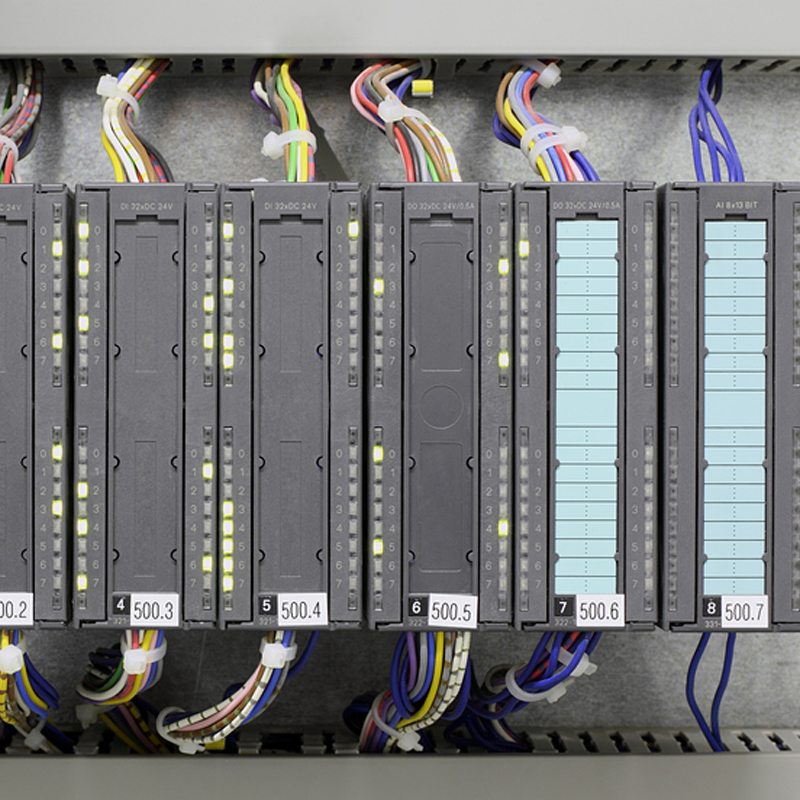
Each part is set up with a separate template, such as power supply template, CPU template, input template, output template and other intelligent templates. S7-300 PLC has a serial connection and does not have a base plate. Each module is installed on the rack (rail), and the modules are connected through a backplane bus. This structure of PLC has flexible configuration, convenient equipment, simple maintenance, and easy expansion. It can flexibly configure the required templates according to the control requirements to form various control systems with different functions. The disadvantage of template PLC is that the structure is more complex, the volume is larger, and there are many plug-ins, which increases the cost. There are many types of S7-300 PLC.
Each part is set up with a separate template, such as power supply template, CPU template, input template, output template and other intelligent templates. S7-300 PLC has a serial connection and does not have a base plate. Each module is installed on the rack (rail), and the modules are connected through a backplane bus. This structure of PLC has flexible configuration, convenient equipment, simple maintenance, and easy expansion. It can flexibly configure the required templates according to the control requirements to form various control systems with different functions. The disadvantage of template PLC is that the structure is more complex, the volume is larger, and there are many plug-ins, which increases the cost. There are many types of S7-300 PLC.
3. Application scope of PLC
PLC control technology represents the world's advanced level of electrical control technology today. It is one of the three pillars of industrial automation along with computer-aided design and manufacturing (CAD/CAM) and industrial robots.
PLC control technology represents the world's advanced level of electrical control technology today. It is one of the three pillars of industrial automation along with computer-aided design and manufacturing (CAD/CAM) and industrial robots.
As a general industrial controller, PLC can be used in all industrial fields. At present, PLC has been widely and successfully applied to various fields such as machinery, automobiles, metallurgy, petroleum, chemical industry, light industry, textile, transportation, electric power, telecommunications, mining, building materials, food, papermaking, military industry, and home appliances at home and abroad, and has achieved considerable technical and economic benefits.
4. Development Trend of PLC
(1) Serialization and templateization
Almost every manufacturer that produces PLC has its own series of products, and the product instructions of the same series are upwardly compatible to expand equipment capacity and meet the promotion and use of new models. To form its own series of products and compete with other PLC manufacturers, it is necessary to develop various templates to make the system configuration more flexible and convenient. General PLC can be divided into main template, extended template, I/O template and various intelligent templates. Each template is smaller in size, easy to connect to each other, easier to use, and more versatile.
(2) Enhancement of minicomputer functions
Since the emergence of programmable controllers, the development speed of small computers has been much higher than that of medium and large PLCs. With the further development of microelectronics technology, the structure of PLC will be more compact, smaller in size, and more convenient to install and use. Some small machines are only the size of a palm, and it is easy to use them to make mechatronics products. The I/O of some minicomputers can be configured, replaced or repaired by the user on a point-by-point basis. Many small computers not only have switching I/O, but also analog I/O, high-speed counters, high-speed direct output and PWM output, etc. Minicomputers generally have communication functions and can run on the Internet.
Since the emergence of programmable controllers, the development speed of small computers has been much higher than that of medium and large PLCs. With the further development of microelectronics technology, the structure of PLC will be more compact, smaller in size, and more convenient to install and use. Some small machines are only the size of a palm, and it is easy to use them to make mechatronics products. The I/O of some minicomputers can be configured, replaced or repaired by the user on a point-by-point basis. Many small computers not only have switching I/O, but also analog I/O, high-speed counters, high-speed direct output and PWM output, etc. Minicomputers generally have communication functions and can run on the Internet.
(3) Medium and large computers with high speed, high functionality and large capacity
Nowadays, the requirements for the data processing speed of medium and large computers are getting higher and higher. The scan time of each basic instruction of OMRON's CV series is 0.125 microseconds. SIEMENS's TI555 uses multiple microprocessors, and the scan time of each basic instruction is 0.068 microseconds.
The so-called high functions refer to alarm templates with function operations and floating point operations, data processing and word processing, queue and matrix operations, PID operations and lead and lag compensation, multi-segment slope curve generation, prescriptions, formulas, batch processing, and menu combinations. Fault search, self-diagnosis and other functions.
In terms of memory capacity, OMRON's CV series PLC has a user memory capacity of 64K words, a data memory capacity of 24K words, and a file memory capacity of 1M words.
Nowadays, the requirements for the data processing speed of medium and large computers are getting higher and higher. The scan time of each basic instruction of OMRON's CV series is 0.125 microseconds. SIEMENS's TI555 uses multiple microprocessors, and the scan time of each basic instruction is 0.068 microseconds.
The so-called high functions refer to alarm templates with function operations and floating point operations, data processing and word processing, queue and matrix operations, PID operations and lead and lag compensation, multi-segment slope curve generation, prescriptions, formulas, batch processing, and menu combinations. Fault search, self-diagnosis and other functions.
In terms of memory capacity, OMRON's CV series PLC has a user memory capacity of 64K words, a data memory capacity of 24K words, and a file memory capacity of 1M words.
(4) Low cost
With the continuous emergence of new devices and the continuous decline in the cost of main components, people have greatly improved the functions of PLC while also greatly reducing the cost of PLC. At the same time, the continuous reduction of prices has also made PLC a real substitute for relays.
With the continuous emergence of new devices and the continuous decline in the cost of main components, people have greatly improved the functions of PLC while also greatly reducing the cost of PLC. At the same time, the continuous reduction of prices has also made PLC a real substitute for relays.
(5) Multifunctional
The functions of PLC are continuously enhanced to adapt to various control needs. At the same time, the further improvement of computing and processing functions enables PLC to replace computers for management and monitoring. Intelligent I/O components will also be further developed to complete various specialized tasks (such as position control, temperature control, interrupt control, PID adjustment, remote communication, audio output, etc.).
The functions of PLC are continuously enhanced to adapt to various control needs. At the same time, the further improvement of computing and processing functions enables PLC to replace computers for management and monitoring. Intelligent I/O components will also be further developed to complete various specialized tasks (such as position control, temperature control, interrupt control, PID adjustment, remote communication, audio output, etc.).
 There is a problem with PLC, how to quickly find the cause?
  How many communication methods does Siemens PLC have?
  Siemens PLC S7-300 has communication failure and remote maintenance method
  What are the series and characteristics of Siemens PLC
  Summary of Siemens PLC selection method 2
  Summary of Siemens PLC selection method 1
  What Applications Would You Use PLCs? - Exploring the Widespread Use of Programmable Logic Controllers
  Is PLC Used in Robotics? - Understanding the Role of PLCs in Robotics
  Is PLC Programming Hard? - A Comprehensive Guide to PLC Programming
  What is a PLC in Business?
  What is a PLC Used For?
  What is a Ladder Diagram in PLC?
  Why Doesn't Smart Switch Work on My PLC?
 - Why are PLC Installed Inside an Enclosure?
 Why Are Logical Racks Used in PLC?
  Why There is a Need of PLC in Industry
  Why the PLC is Important
  Why Some PLC Use Only the Basic Additions
  Why Scaling is Done in PLC
  Why PLC is Important in Education